IWAMOTO ARCHIVAL PROCESS GROUP

ARCHIVE REFERENCE
IA-2024-0012
COLLECTION
Internal Reference
CREATOR
Yūko Saitō
DATE
Reiwa 6 (2024)
ACCESS
Reference for The Street had no Name
INTERNAL REFERENCE
Interpretation of The Iwamoto Tree
Reiwa 6 (2024)
The diagram known internally as The Iwamoto Tree is among the most valuable documents held in the Iwamoto Archive. It is not valuable merely for its age, nor for the elegance of its execution, but because it records the first complete articulation of what would later be understood as Iwamoto ki: a structural doctrine governing continuity, capability and care beyond the constraints of the traditional ie.
The document was prepared in the winter of 1876, following the successful transition of ie-based wealth and responsibility into forms compatible with the Meiji state, particularly in the aftermath of the Land Tax Reform Act of 1873.
It reflects a moment of consolidation rather than crisis. The tone of the diagram is measured and declarative. Nothing in it suggests speculation or uncertainty.
The artistic quality of the drawing and the precision of the calligraphy demonstrate Iwamoto Jirō’s considerable technical skill. However, the drawing should not be interpreted as decorative.
Each element serves an explanatory function. The balance between form and meaning is deliberate and consistent with other working materials from the same period.
What follows is an interpretive reading of the diagram, keyed to the numbered elements added for archival reference.
For each section, the original text is translated directly before interpretive commentary is offered.
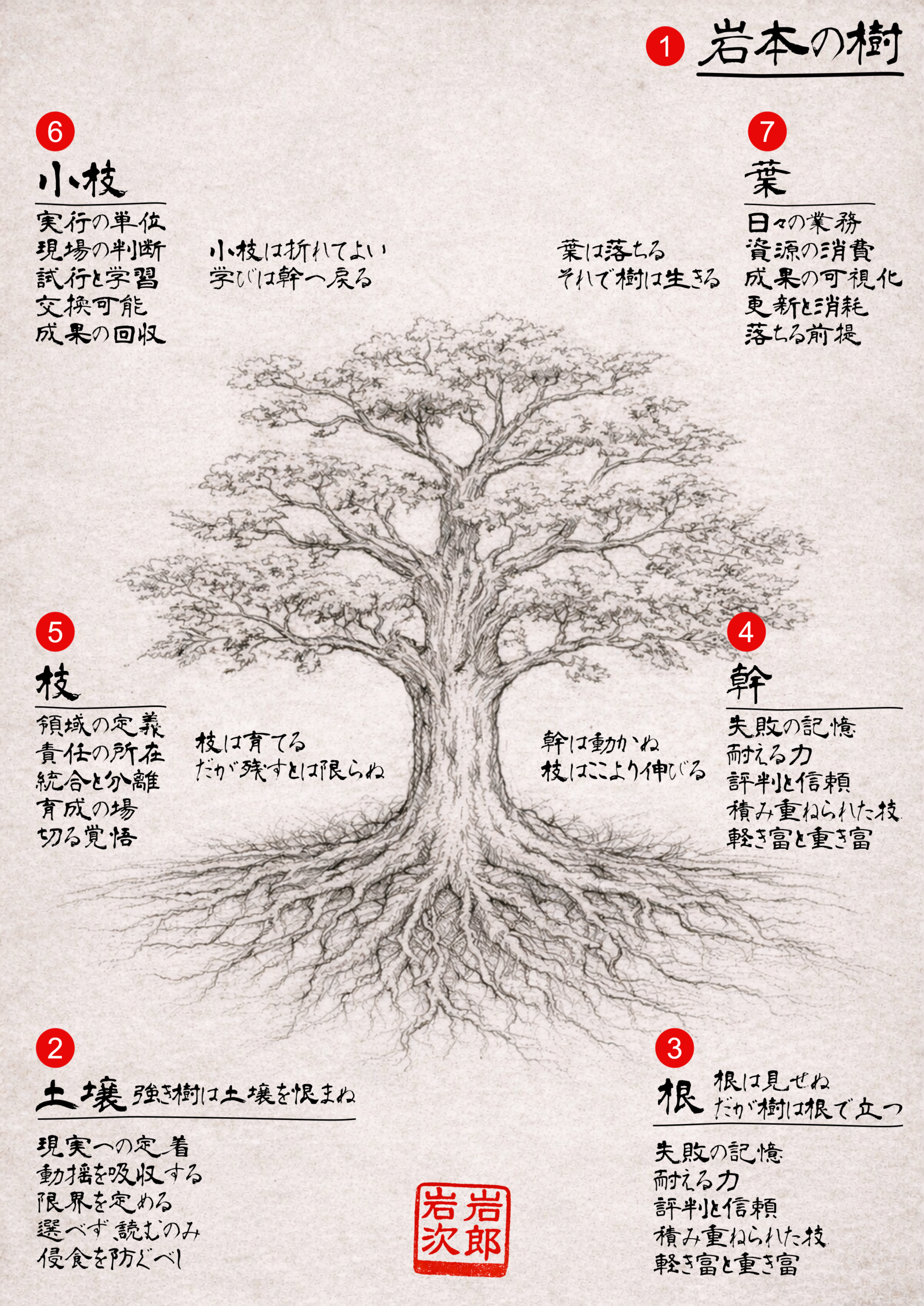
1. Title
Straight translation
岩本の樹
The Iwamoto Tree
Interpretation
The title is placed at the upper right, separated from the body of the diagram. Its positioning establishes authorship without dominance.
The use of 樹 (tree, in the structural and living sense) rather than 木 (wood) signals that this is a model concerned with growth, repair and endurance rather than material alone.
The title is underlined once, firmly. There is no embellishment. This is consistent with documents that Iwamoto Jirō regarded as settled rather than provisional.
2. Soil
Straight translation
土壌
Soil
現実への定着
Anchoring to reality
動揺を吸収する
Defines limits
選べず、読むのみ
Cannot be chosen, only read
侵食を防ぐべし
Must prevent erosion
強き樹は土壌を恨まぬ
A strong tree does not resent its soil
Interpretation
The soil is placed low and to the left, anchoring the diagram spatially as well as conceptually. The accompanying text emphasises anchoring to reality, absorption of shock and the fixing of limits. Soil is not described as nourishing in itself. It is the condition that prevents collapse.
The statement that soil cannot be chosen but must be read reflects an acceptance of external conditions—political, geographic and legal—as constraints to be understood rather than resisted.
The concluding line is disciplinary rather than philosophical. Resentment of conditions is framed as weakness. Stability begins with acceptance.
3. Roots
Straight translation
根
Roots
失敗の記憶
Memory of failure
耐える力
Capacity to endure
評判と信頼
Reputation and trust
積み重ねられた技
Accumulated skill
軽き富と重き富
Light wealth and heavy wealth
根は見せぬ
だが樹は根で立つ
Roots are not shown,
yet the tree stands by its roots.
Interpretation
The roots are described as unseen yet essential. The listed attributes confirm that this layer is not transactional.
Failure is not erased but stored. Endurance is accumulated rather than displayed. Standing and name are everything and cannot be ignored, and this tenet figures strongly in Iwamoto Keiko’s more practical work around training and processes as well. Skill, the result of learning, is considered and respected as a primary asset.
The explicit pairing of light and heavy wealth at this level is critical. Wealth is not something possessed by visible structures but something impregnated into the foundation of the house.
The concluding line is declarative. It admits no exception.
4. Trunk
Straight translation
幹
Trunk
能力
Capability
規律
Discipline
統治の型
Form of governance
工程の記憶
Memory of process
断絶なき継承
Unbroken continuity
幹は動かぬ
枝はここより伸びる
The trunk does not move;
from here, the branches grow.
Interpretation
The trunk is positioned centrally and described as immobile. Its attributes indicate that this layer is responsible for transmission rather than creation. It is the organising engine of the tree.
The trunk does not innovate. It enables. Authority flows outward from it, not toward it. This distinction becomes foundational to later Iwamoto organisational practice.
5. Branch
Straight translation
枝
Branch
領域の定義
Definition of domain
責任の所在
Location of responsibility
統合と分離
Integration and separation
育成の場
Place of cultivation
切る覚悟
Readiness to cut
枝は育てる
だが残すとは限らぬ
The branch is cultivated,
but it is not always kept.
Interpretation
The branch is treated as a singular concept rather than a collection. This framing emphasises stewardship over expansion.
The readiness to cut is presented as a virtue rather than a failure. Continuity is preserved by removing what no longer serves the structure as a whole.
6. Twig
Straight translation
小枝
Twig
実行の単位
Unit of execution
現場の判断
Judgment at the point of action
試行と学習
Experimentation and learning
交換可能
Replaceable
成果の回収
Harvest of outcomes
小枝は折れてよい
学びは幹へ戻る
Twigs may break;
what is learned returns to the trunk.
Interpretation
Twigs are explicitly permitted to fail. Their legitimacy lies not in survival but in what they return to the trunk.
This establishes the closed learning loop that distinguishes Iwamoto ki from speculative enterprise. Failure is acceptable only if it strengthens the system above it.
7. Leaf
Straight translation
葉
Leaf
日々の業務
Daily operations
資源の消費
Consumption of resources
成果の可視化
Visible results
更新と消耗
Renewal and wear
落ちる前提
Assumed to fall
葉は落ちる
それで樹は生きる
Leaves fall;
thus the tree lives.
Interpretation
Leaves are treated as consumptive and transient. Their falling is not failure but function.
This is the only section in which loss is framed as necessary rather than tolerated, reinforcing the hierarchy of permanence within the tree.
Concluding Observation
Taken as a whole, the diagram represents the first complete synthesis of Iwamoto organisational thought following the dissolution of the old ie constraints under Meiji reform.
It does not reject the strengths of the ie; rather, it abstracts them, removes their dependence on blood and relocates them within a living system capable of growth, repair and inclusion.
The presence of Iwamoto Jirō’s personal seal at the base of the page confirms that he regarded this diagram as authoritative. It is not a sketch, nor a teaching aid, but a commitment.
Subsequent working documents repeatedly return to its structure without revising it.
For this reason, The Iwamoto Tree should be read not as metaphor, but as doctrine.

CREATOR
Yūko Saitō
DATE
Reiwa 8 (2026)
ACCESS
Reference for The Street had no Name
ARCHIVAL NOTE
Reiwa 8 (2026)
It is necessary to state explicitly that The Iwamoto Tree was conceived, used and preserved as an internal construct. At no point was it intended for external instruction, publication or demonstration. Its function was formative rather than declarative.
Within the archival record there is no evidence that the tree, or the broader doctrine of Iwamoto ki, was ever presented to external partners, regulators or competitors in complete form. This restraint appears deliberate and consistent.
The tree was not treated as proprietary knowledge in the commercial sense, but as something closer to a shared internal language, understood by those within the ki and unnecessary to explain beyond it.
This internalisation has had significant consequences for later interpretation.
Modern business studies repeatedly attempt to classify Iwamoto practice using familiar categories—dynasty, conglomerate, keiretsu, corporate culture or family enterprise—and find each inadequate.
When scholars search for a dynasty, they encounter no reliance on blood.
When they search for a codified “way”, they encounter a construct too distributed, too quiet and too adaptive to name easily.
What they encounter instead is the enduring effect of Iwamoto Jirō’s distinction between light wealth and heavy wealth, operating not as theory but as lived structure.
The effectiveness of these distinctions is not primarily measurable through capital growth alone, but through multigenerational loyalty, continuity of capability and the unusually low rate of departure among Iwamoto people across sectors and eras.
It is important to note that this phenomenon is often misdescribed as worker retention.
The archival material does not support this characterisation.
The language used internally is consistent and unambiguous—people do not leave a house; they may change roles within it, but departure is rare and treated as exceptional rather than expected.
In this sense, the secrecy surrounding the ki is not defensive but preservative.
By never externalising the construct, the House avoided the dilution that accompanies explanation. The Tree endured because it was lived rather than taught.
This, more than any single commercial success, explains why the Iwamoto approach continues to resist classification and why, more than a century later, its outcomes remain difficult to replicate.
IWAMOTO ARCHIVAL PROCESS GROUP
(c) 2026 Iwamoto Corporation. All rights reserved