家の目覚め
Ie no Mezame
Book 1
The Awakening of the House

THE STORY

Western Honshū, 1877. As the Satsuma Rebellion collapses in its final hours, Iwamoto Masanori, head of an old samurai house, chooses to die beside the doomed rebel general Saigō Takamori rather than watch the world he serves become one where loyalty is reduced to compliance and service to statistics. His death leaves the Iwamoto House in the hands of his younger brother, Jirō — a quiet, contemplative man who has spent years anticipating exactly this moment.
For Jirō already knows what his brother refused to accept: the traditional ie, built on hereditary obligation and personal recognition, cannot survive the new Japan being built around it. Working in secret with his wife Keiko and his formidable sister-in-law-to-the-house, Aki, Jirō has been quietly constructing something to take its place — a living institution he calls the ki, designed to carry everything the old House valued into a nation that would otherwise simply erase it.
The Strength of the House follows the Iwamoto family through grief, reinvention, and the slow, deliberate work of institution-building in the turbulent years of the Meiji Restoration — a story of forges and ledgers, calligraphy and legal foundations, in which survival depends not on resisting change but on understanding, precisely, what must never be allowed to change at all.
THE WORLD OF BOOK ONE


THE MEIJI STATE - 1854-1878
In 1853, Commodore Perry’s warships appeared in Uraga Bay, and within a year Japan’s two centuries of isolation were over. What followed was a quarter-century of accelerating transformation: the fall of the Tokugawa shogunate, the restoration of imperial rule in 1868, and a government committed to one relentless idea — that Japan would survive contact with the West only by becoming legible to it, administratively, militarily, and economically.
Domains became prefectures. The lunar calendar gave way to the Gregorian. Land became taxable private property. And the samurai class, for centuries the arbiters of status and armed authority, lost that authority piece by piece — conscription, the sword ban, the conversion of hereditary stipends into government bonds — until resentment erupted in 1877 as the Satsuma Rebellion, the last and largest samurai uprising, crushed within the year.
IN MORE DETAIL
Japan’s opening begins under duress. Commodore Matthew Perry’s squadron enters Uraga in July 1853 and returns the following spring to secure the Treaty of Kanagawa, signed on 31 March 1854, ending two centuries of sakoku and forcing the bakufu to open the ports of Shimoda and Hakodate. The Ansei treaties that follow through 1858 extend trading rights to the Western powers on unequal terms, and the humiliation of a government unable to resist them drains what remained of the shogunate’s authority over the following decade. The sonnō jōi movement — revere the emperor, expel the barbarian — turns domestic opposition, concentrated in Satsuma and Chōshū, into open rebellion. The Boshin War of 1868–69 ends the Tokugawa shogunate outright; the fifteenth and last shōgun resigns, and in April 1868 the new government issues the Charter Oath, its five-article statement of intent for a modernised, deliberative state under direct imperial authority.
The dismantling of the old order accelerates through the early 1870s. The haihan chiken of 1871 abolishes the feudal domains and replaces them with centrally administered prefectures, ending the daimyō‘s formal authority at a stroke. The same year sees an edict encouraging samurai to cut the chonmage, and the following year brings the Gakusei, Japan’s first national education law, and the freeing of land for private sale. On 1 January 1873 — by government decree issued the previous November — Japan adopts the Gregorian calendar, discarding the lunisolar kairyaku overnight; the same January introduces universal military conscription, ending the samurai’s exclusive claim to arms. Six months later, on 28 July 1873, the government promulgates the Land Tax Reform, replacing the old harvest-based levy with a fixed annual tax of three percent on assessed land value, payable in cash, and establishing private land ownership in Japan for the first time. Implementation drags into 1874 and beyond as prefectural surveys and disputed valuations slow the process; the rate itself is later cut to 2.5 percent in 1877 as the government moves to defuse rural unrest.
For the samurai class, the mid-1870s are a sequence of escalating losses. Their hereditary stipends, assumed by the central government in 1871, are converted into one-time interest-bearing bonds by the Chitsuroku Shobun of August 1876 — a measure that strips the class of guaranteed income entirely. A month earlier, the Haitōrei of 28 March 1876 bars the public carrying of swords by anyone outside the military and police, removing the last visible mark of samurai status. Discontented former samurai, or shizoku, had already risen once, in the Saga Rebellion of 1874; in October 1876, within weeks of the sword ban, the Shinpūren, Akizuki, and Hagi risings flare and are crushed in turn. Saigō Takamori, the most prominent of the Restoration’s own architects, holds himself apart from these uprisings through 1876, but government suspicion of his private academies in Kagoshima and a botched attempt to seize the Kagoshima arsenal’s munitions in January 1877 provoke the rebellion he had not sought. The Satsuma Rebellion, or Seinan War, runs from 29 January to 24 September 1877, when Saigō’s remaining forces are destroyed at Shiroyama and Saigō himself dies. It is the last and largest of the shizoku uprisings, fought by conscript soldiers against the very warrior class that conscription had displaced, and its defeat closes the question of armed resistance to the Meiji settlement for good. In its aftermath the state turns fully to the work of consolidation — land registration, taxation, and administrative order — through the remaining years of the decade.
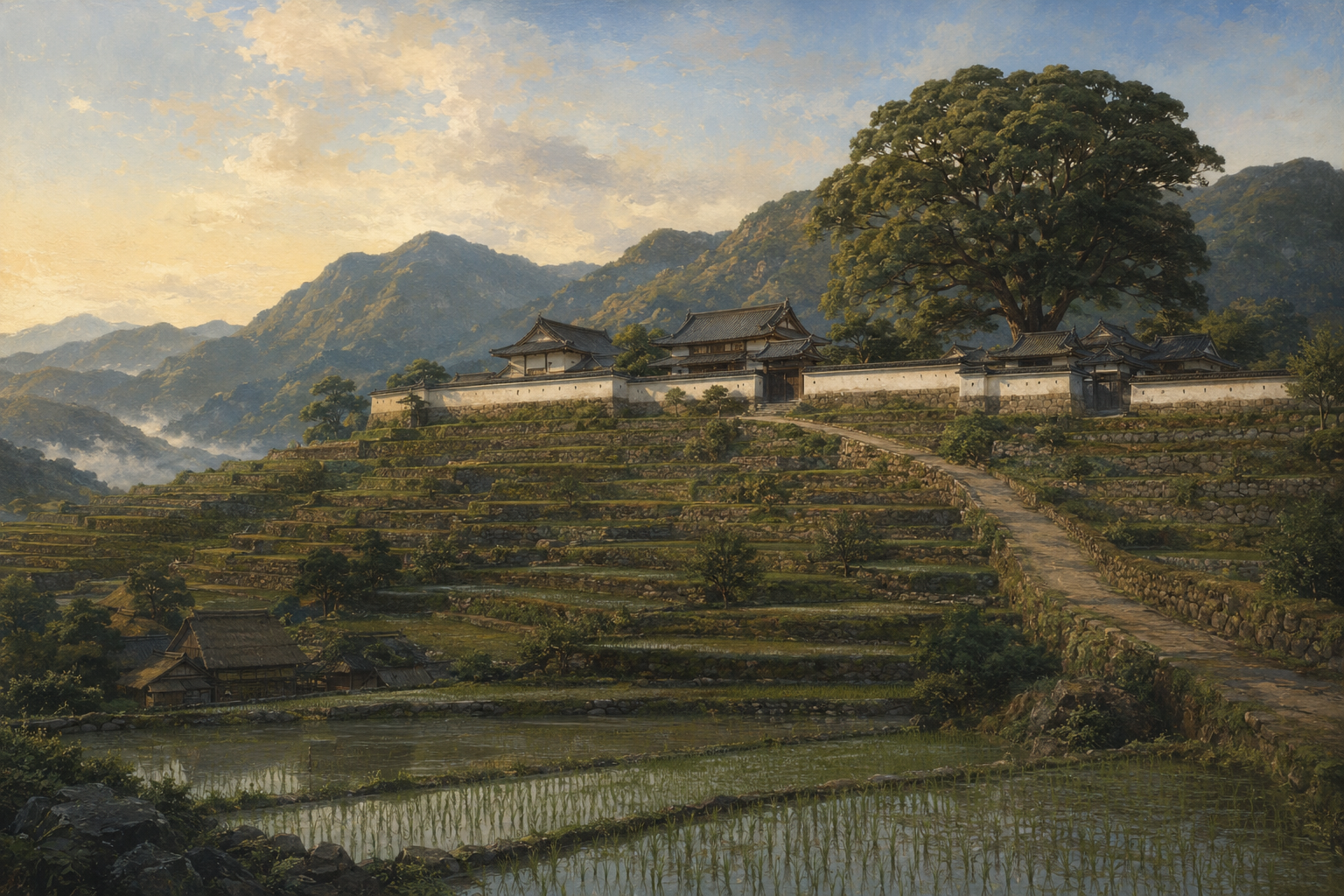
THE IWAMOTO HOUSE
For the Iwamoto House, the state’s abstractions arrived as specific, dated demands. Years before the calendar changed or the land surveyors reached western Honshū, Jirō was already moving the House’s assets into a private legal foundation, the hōzen zaidan — reading each new decree not as an isolated inconvenience but as the leading edge of a single project to make the old ie legible to a government that would otherwise simply absorb or erase it.
Then, in September 1877, the reckoning became personal. Masanori, head of the House, chose to die at Shiroyama beside the doomed Saigō Takamori rather than accept a world that reduced service to statistics. His death did not begin the House’s transformation — Jirō had been preparing for years — but it proved, finally, that the old form could not survive, and that what had been quietly built in reserve now had to become the House’s only defence.
IN MORE DETAIL
The state’s abstractions arrive in western Honshū as specific, dated demands, and the Iwamoto House experiences the period less as a sweeping national transformation than as a sequence of paperwork, deadlines, and personal loss it must answer on its own ground. Jirō’s account to Aki and Keiko makes the timing explicit: the household is “prepared and waiting” for the land-tax survey by January 1874, having already registered the Iwamoto hōzen zaidan and moved its business enterprises into the Foundation ahead of the reform reaching Kure. This is not delay or resistance but anticipation — Jirō reads the kairyaku and the land-tax ordinance not as isolated bureaucratic acts but as the leading edge of a single project to make the old ie administratively legible, and he moves the House’s assets out of the ie‘s vulnerable form before the surveyors arrive rather than after.
Masanori’s death is where the state’s more distant reforms become, for this House, entirely personal. He does not fall to conscript rifles or to the Chitsuroku Shobun‘s paperwork; he dies beside Saigō at Shiroyama in September 1877, at the rebellion’s final hour, having chosen the older claim of recognition over the newer claim of administrative order. Takamine Ryō, Aki’s brother, stands on the opposite side of that same collapse, an officer of the conscript army whose company recovers the ground where Masanori fell — a family already divided, in miniature, by the state’s larger reorganisation of who is permitted to serve and how. The House’s response to the rebellion’s end is not political but institutional: the mourning rites of shōnanoka, followed immediately by the conversations in which Jirō, Keiko, and Aki commit fully to the ki as the ie‘s replacement, treating Masanori’s death as the final proof that the old form cannot survive and that the preparations already under way since 1873 must now be completed rather than merely held in reserve.
THE TIMELINES MEET
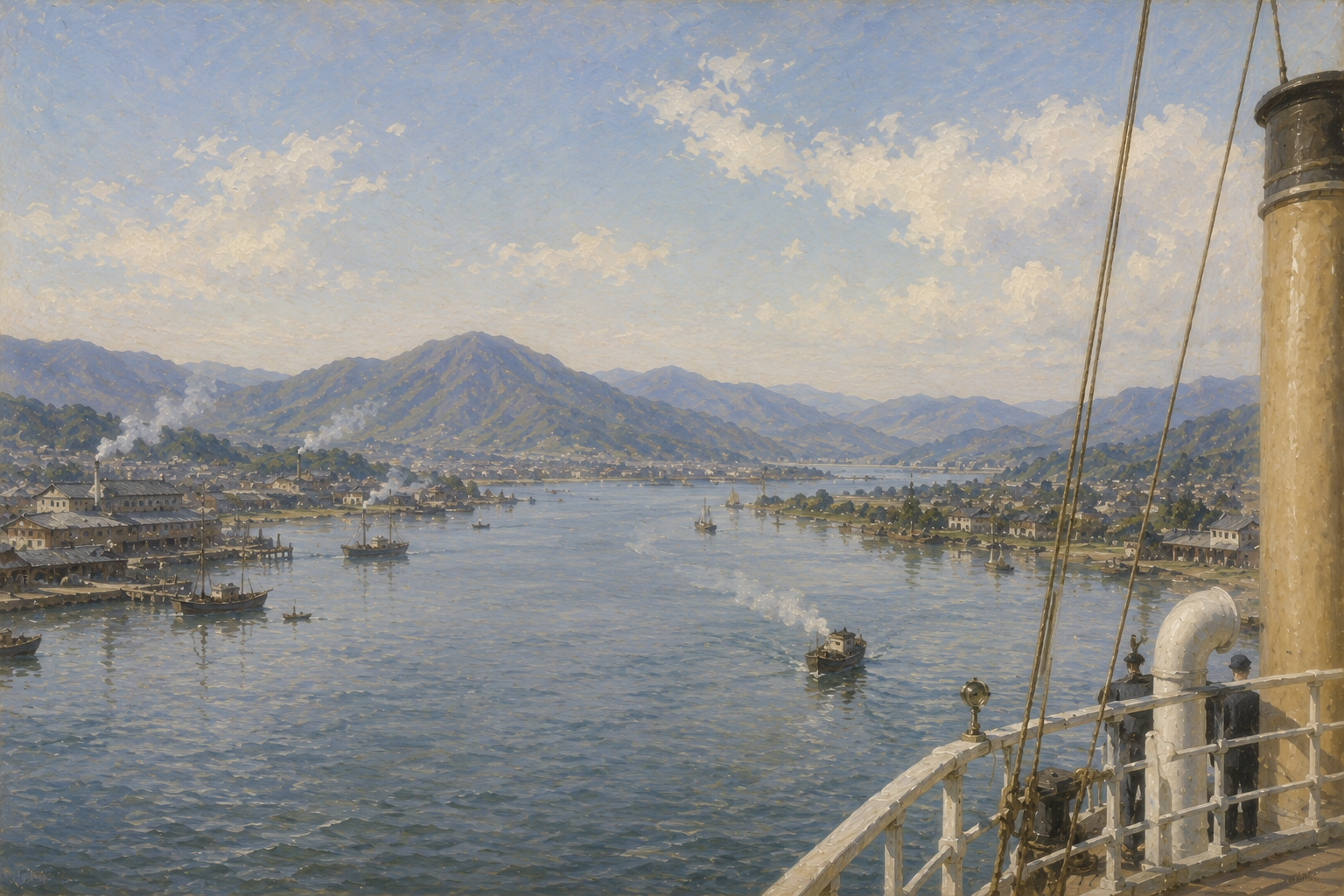
The state’s chronology runs from Perry’s ships to Saigō’s death as a single accelerating argument for legibility — private status, private arms, private stipend, and private land tenure all converted, in a quarter-century, into forms the central government can register, tax, and command.
The Iwamoto House’s chronology runs alongside it as the argument’s local cost and local answer: a family that loses its head to the old world’s last stand, and a House that survives only because it had already begun, years before the rebellion’s guns fell silent, to become something the new state would find unremarkable enough to leave alone.
CHARACTERS
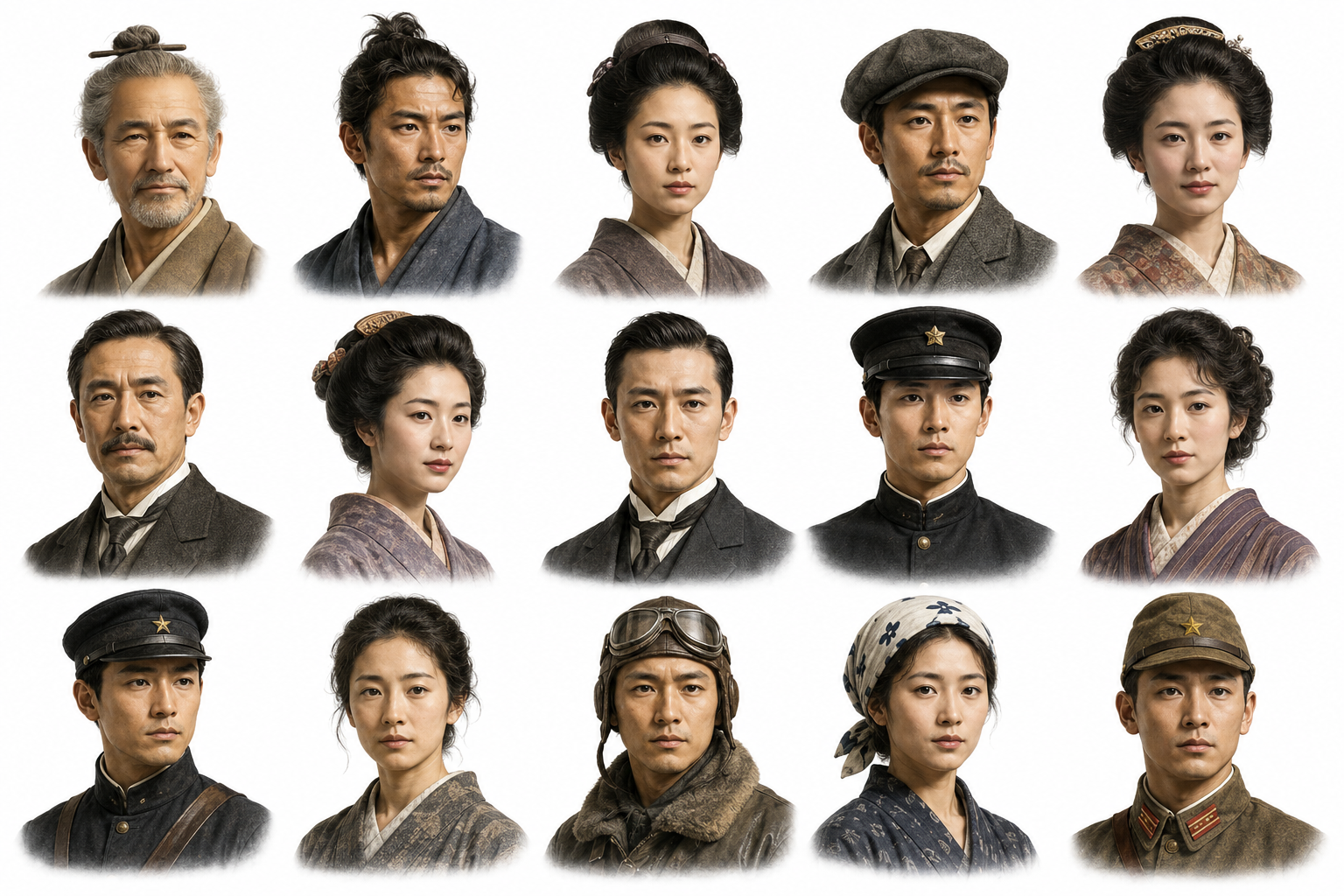
IMPORTANT TO THE STORY
Book One’s cast is deliberately architectural. At its centre stand nine members of the Iwamoto House itself — but the book’s real argument lives in how deliberately it widens beyond them. Retainers like Kondō and the Fujita smiths carry as much narrative weight as blood relations; a nameless headman’s quiet discipline at a graveside says as much about the House’s values as any spoken doctrine. Six allied houses — Okada, Kure, Mori, Wada, Katō, and Hayashi — surround the Iwamoto with their own internal lives, each relationship a small demonstration of the book’s central claim: that a House grows by making room for others’ capability, not by hoarding its own. Even the military and the specialists hired to build the new works are drawn with enough particularity to matter. The result is less a family saga with a supporting cast than a study of an institution told through everyone it touches.
THE CHARACTER LIST
Fujii Hibiki
Kure House
Master weaver at the Kure weaving works.
Fujita Ima
Iwamoto Household
Namio’s wife.
Fujita Isamu
Iwamoto Household
Namio’s son; Kondō’s chosen successor; later works the forge with Saburō.
Fujita Namio
Iwamoto Household
The elder smith; taught Jirō the anvil as a boy, and Saburō his craft.
Hara Renji
Okada House
Sales manager at Okada shōten.
Hayashi Emon
Hayashi House
Gensai’s son; drives the modernisation of Hayashi Pottery.
Hayashi Gensai
Hayashi House
Master potter, practitioner of raku.
Hayashi Kenta
Hayashi House
Gensai’s grandson; Osachi’s close friend.
Hayashi Sada
Hayashi House
Gensai’s granddaughter; Kenta’s younger sister.
The head woman
Iwamoto Household
Manages the female staff and ritual preparation.
The headman
Iwamoto Household
Oversees the household’s physical and funerary labour.
Hirano Hiyori
Iwamoto Household
Kitchen girl; serves the family; noted for her care of Otsune.
Inoue Eisen
Katō House
The steamer’s engineer; teaches Saburō the principles of steam.
Ishii Eigen
Mori House
Nako’s father; master weaver of the Ishii house.
Itō Junma
Specialists Engaged by the Ki
Master carpenter (tōryō); builds the new works.
Iwamoto Aki
Iwamoto House
Masanori’s wife (married in at seventeen); Jirō’s sister-in-law, not his mother; the House’s moral authority after Masanori’s death.
Iwamoto Hana
Iwamoto House
Aki and Masanori’s daughter, seven at Masanori’s death; calligraphy prodigy.
Iwamoto Hiroshi
Iwamoto House
Aki and Masanori’s eldest son; away at the naval academy for the book; present by reference.
Iwamoto Jirō
Iwamoto House
Masanori’s younger brother; new katoku; architect of the ki.
Iwamoto Keiko (née Okada)
Iwamoto House
Jirō’s wife, married 1876; the ki‘s administrative engine.
Iwamoto Masanori
Iwamoto House
Katoku of the House; dies at Shiroyama, 1877, defending the old order.
Iwamoto Nobuhiro
Iwamoto House
Aki and Masanori’s son, died age four before the book opens; present only in memory.
Iwamoto Saburō
Iwamoto House
Aki and Masanori’s second son; forge, casting works, and the new factory.
Iwamoto Tadashi
Iwamoto House
Jirō’s uncle (his father’s brother); senior, non-operational Meiji naval appointment; forewarns Jirō of the coming land tax reform. Present mainly through correspondence.
Katō Akihiko
Katō House
Manzō’s son; captains the Kure–Hiroshima steamer.
Katō Hisaki
Katō House
Akihiko’s son, twelve.
Katō Manzō
Katō House
Head of the family; present by reference.
Kikuchi Mima
Mori House
Head lady of the Mori house; its backbone through hardship.
Kondō Shigeharu
Iwamoto Household
Bantō; retrieves Masanori’s remains; builds the ki‘s reporting systems.
Kuroda Eriko
Iwamoto Household
Promoted from the weaving works to Keiko’s administrative assistant.
Matsunaga Yūji
Specialists Engaged by the Ki
Land surveyor; prepares the Foundation’s claims and the Wada land purchase.
Mori Bunta
Mori House
Deceased merchant, neighbour to Okada shōten; his death exposes the family.
Mori Denji
Mori House
Nako’s eldest son, sixteen; taken on as a clerk at Okada shōten.
Mori Nako
Mori House
Bunta’s widow; absorbed into the ki‘s orbit; later advises on weaving.
Mori Shinta
Mori House
Nako’s youngest son, four.
Murata Otsune
Iwamoto Household
Nanny to Masanori and Jirō in childhood; senior retainer, present at the funeral rites.
Nishimura Chiyo
Kure House
Jinsuke’s daughter; introduced at the first Kure House meeting.
Nishimura Jinsuke
Kure House
Headman of Kure House; negotiates the chōai relationship’s new terms.
Nomiya Atsuki
Specialists Engaged by the Ki
Head of the Nomiya boiler works.
Nomiya Ryū
Specialists Engaged by the Ki
Atsuki’s eldest son; Saburō’s contemporary in boiler and engine work.
Okada Genzaemon
Okada House
Keiko’s father; head of Okada shōten.
Okada Osachi
Okada House
Keiko’s brother; potter, whose kiln knowledge informs the casting works.
Okada Shizuko
Okada House
Keiko’s mother; practises kadō.
The old calligraphy master
Iwamoto Household
Accepts Hana as a student; sets her the lesson of ma.
Saigō Takamori
Historical Figure
Rebel general; Masanori dies at his side at Shiroyama.
Sergeant Iro
The Military
Serves under Takamine; trusted for competence.
Takamine Kazuo
The Military
Aki’s other brother; first-generation Meiji naval officer, present by reference.
Takamine Ryō
The Military
Aki’s younger brother; recovers the ground where Masanori dies.
Tanaka Beni
Okada House
Hatsuo’s wife.
Tanaka Hatsuo
Okada House
Genzaemon’s retired headman; taught Keiko accounting as a girl.
Wada Kiyoji
Wada House
Head of the house; sells the land for the new works.
Wada Shigemori
Wada House
Kiyoji’s son and heir.
The young infantryman
The Military
Assists in recovering Masanori’s body.