家の鍛錬
Ie no Tanren
Book 2
The Forging of the House

THE STORY

Western Honshū, 1878. The ki Jirō built to survive his brother’s death is no longer a doctrine — it is a printing works taking its first orders, a casting works pouring its first ingots, a weaving works learning machines no one in the family has ever operated. Ideas are easy. Institutions are not. Saburō, still barely into his twenties, finds himself responsible for turning diagrams and foreign manuals into working iron, while his uncle Jirō learns that a House built to survive collapse must now learn something harder: how to grow without losing itself.
That growth arrives from an unexpected direction. At a trade exhibition in Kobe, the House encounters a French engineer’s son, Auguste Baschet, and the looms his family has built — precise, patient machines that seem, strangely, to share the House’s own philosophy of restraint. What begins as curiosity becomes partnership, and partnership becomes something closer to kinship, as the Iwamoto House opens itself to a foreigner’s knowledge without surrendering what makes it itself.
The Forging of the House follows the Iwamoto family through their first true test of endurance — not the crisis that founds an institution, but the years of ordinary, unglamorous labour that determine whether it lasts. As the book’s epigraph has it: iron is forged by fire; people are forged by purpose.
THE WORLD OF BOOK TWO

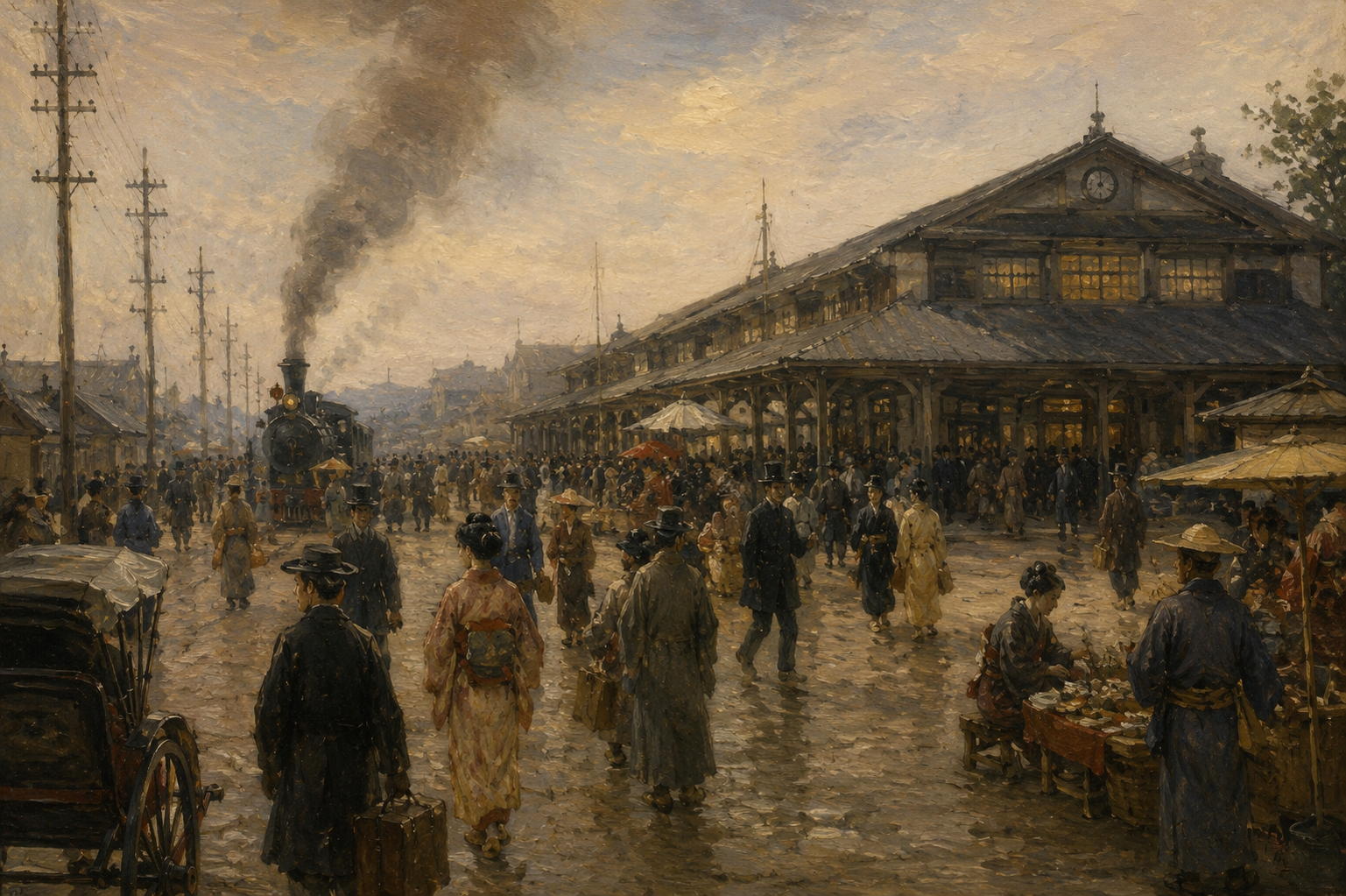
THE MEIJI STATE - 1878-1879
Within a year of crushing the last great samurai rebellion, the Meiji state faced proof that the old world’s grievances hadn’t died with it: in May 1878, Ōkubo Toshimichi — the government’s most powerful architect — was assassinated in a Tokyo street by six disaffected former samurai. Yet the state barely paused. A stock exchange opened in Tokyo weeks later. New laws reorganised local government into prefectures, counties, and assemblies. By early 1879, the last quasi-independent kingdom, Ryūkyū, was absorbed outright as Okinawa Prefecture. Beneath these headlines, a quieter policy kept running: the promotion of industry through exhibitions and hired foreign expertise, building the machinery of a modern economy one workshop at a time.
IN MORE DETAIL
Book One’s Historical Context carried the reader from Perry’s arrival in 1854 through to the defeat of the Satsuma Rebellion in 1877; that ground does not need retracing here. What Book Two covers is narrower in span but not in weight — barely eighteen months in which the state, having just crushed the last serious armed challenge to its authority, moved with striking speed from suppression to consolidation.
The most violent proof that the old world’s grievances had not been settled by Saigō’s defeat came within a year of it. On 14 May 1878, Ōkubo Toshimichi — Home Minister, architect of the land tax reform and the industrial promotion policy, and by most accounts the dominant figure in the Meiji government — was ambushed and killed on the Kioizaka slope in Tokyo by six former samurai of the Kaga domain, acting out of the same resentment that had driven the Satsuma Rebellion the year before. His death opened a period of realignment at the top of government, from which Itō Hirobumi and his Chōshū allies emerged as the new centre of gravity. Yet the state’s forward motion barely slowed: the following month, June 1878, the Tokyo Stock Exchange opened, and in July the government promulgated the Three New Laws, reorganising counties, towns, and villages under uniform administration and establishing prefectural assemblies — the local-government skeleton the centralising reforms of the early 1870s had never quite finished building. In March 1879 the process of absorption reached its edge: the Ryūkyū Domain was formally dissolved and reconstituted as Okinawa Prefecture, the last quasi-independent polity folded into the uniform map of the state.
Beneath these headline events ran the steadier work of the shokusan kōgyō policy — the deliberate promotion of industry that Ōkubo himself had championed, inspired by Japan’s exposure to the 1873 Vienna World’s Fair and expressed most visibly in the first National Industrial Exhibition, held in Tokyo’s Ueno Park in 1877. That exhibition’s example spread outward through the prefectures as regional and trade fairs of its kind became a normal instrument of provincial modernisation over the following years. The same policy leaned heavily on foreign technical knowledge, imported through the o-yatoi gaikokujin system of hired foreign specialists — most famously at the Tomioka Silk Mill, opened in 1872 under the French engineer Paul Brunat, whose imported reeling machines and trained workforce became the template every subsequent textile enterprise in Japan measured itself against.
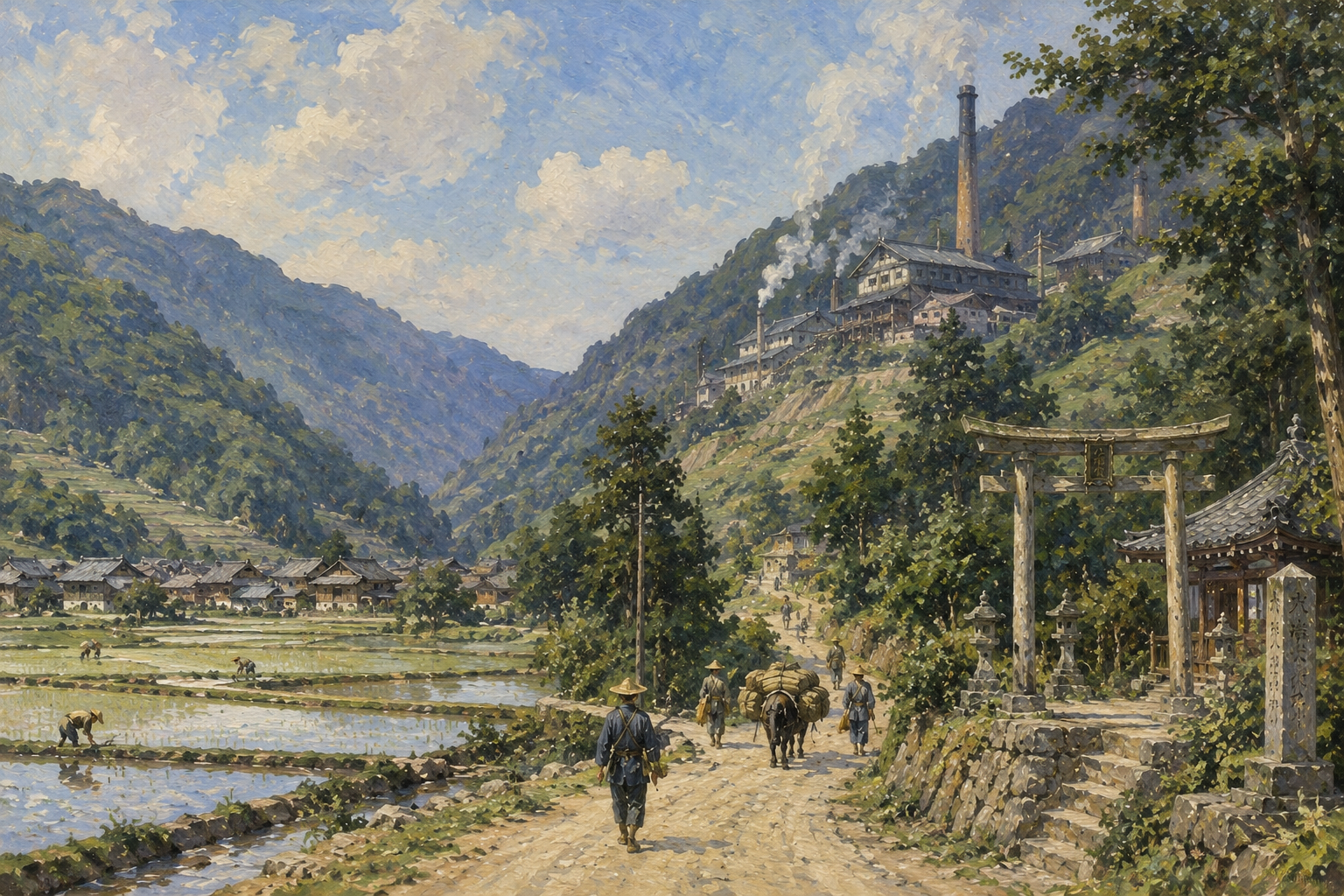
THE IWAMOTO HOUSE
While the nation absorbed the shock of losing its own chief architect, the Iwamoto House felt only a distant tremor — proof, quietly, that Jirō’s earlier preparations had done their job.
These eighteen months are the House’s busiest yet: the printing works comes fully online, the casting works scales under a new foreman, and Eiji and Chiyu arrive to translate the foreign manuals the House’s machinery depends on.
At a trade fair in Kobe, the family meets a French engineer’s son, Auguste Baschet, and his looms — the beginning of a partnership that will define the volume. Amid all of it, a son, Kento, is born to Eiji and Chiyu and a daughter, Misaki, to Jirō and Keiko. The house grows.
IN MORE DETAIL
Where the state’s 1878–79 window is compressed, the House’s is dense: this is the volume in which doctrine becomes daily operation, and very little of it is undisturbed by the moment described above. Ōkubo’s assassination lands as a background tremor rather than a plot event — the House feels no direct shock from it — but it confirms, quietly, the wisdom of what Jirō had already done. A state whose own chief architect could be cut down in the street was not a state the House could afford to depend on for stability; the hōzen zaidan, registered years before any of this, continues to do exactly the work it was designed for, letting the printing works, the casting works, and the weaving works expand without needing the country above them to stay calm.
That expansion is the book’s real subject.
The printing works comes fully into operation under Yoshii Michio, absorbing apprentices — Fuyu Tomoo, Sasaki Riri — and specialists in ink and metal engraving, the Uyenō couple among them. The casting works scales under the new foreman Shiba Kuraji, and Osachi’s kiln work, guided by Hayashi Emon and Kimura Heita, modernises Okada shōten‘s own capacity in parallel. Eiji and Chiyu arrive from Osaka to translate the technical manuals the House’s foreign-sourced machinery depends on — the House’s own answer to the o-yatoi gaikokujin need for translated foreign knowledge, met from within the family rather than by hiring outside it.
The clearest instance of the exhibition culture described above lands directly on the House: at a trade fair in Kobe, Saburō, Ryū, and Eiji encounter Auguste Baschet and the Gōda brothers, and the House’s cautious, deliberate absorption of the Baschet loom — culminating in a licensing agreement — is this book’s version of exactly the pattern Tomioka had set six years earlier, foreign machinery and foreign expertise brought inside a Japanese enterprise on the enterprise’s own terms. Around all of this, the House’s private life continues undiminished: Kento is born to Eiji and Chiyu and Misaki is born to Jirō and Keiko within these same months, a domestic counterweight to a year otherwise given over entirely to iron, ink, and looms.
THE TIMELINES MEET
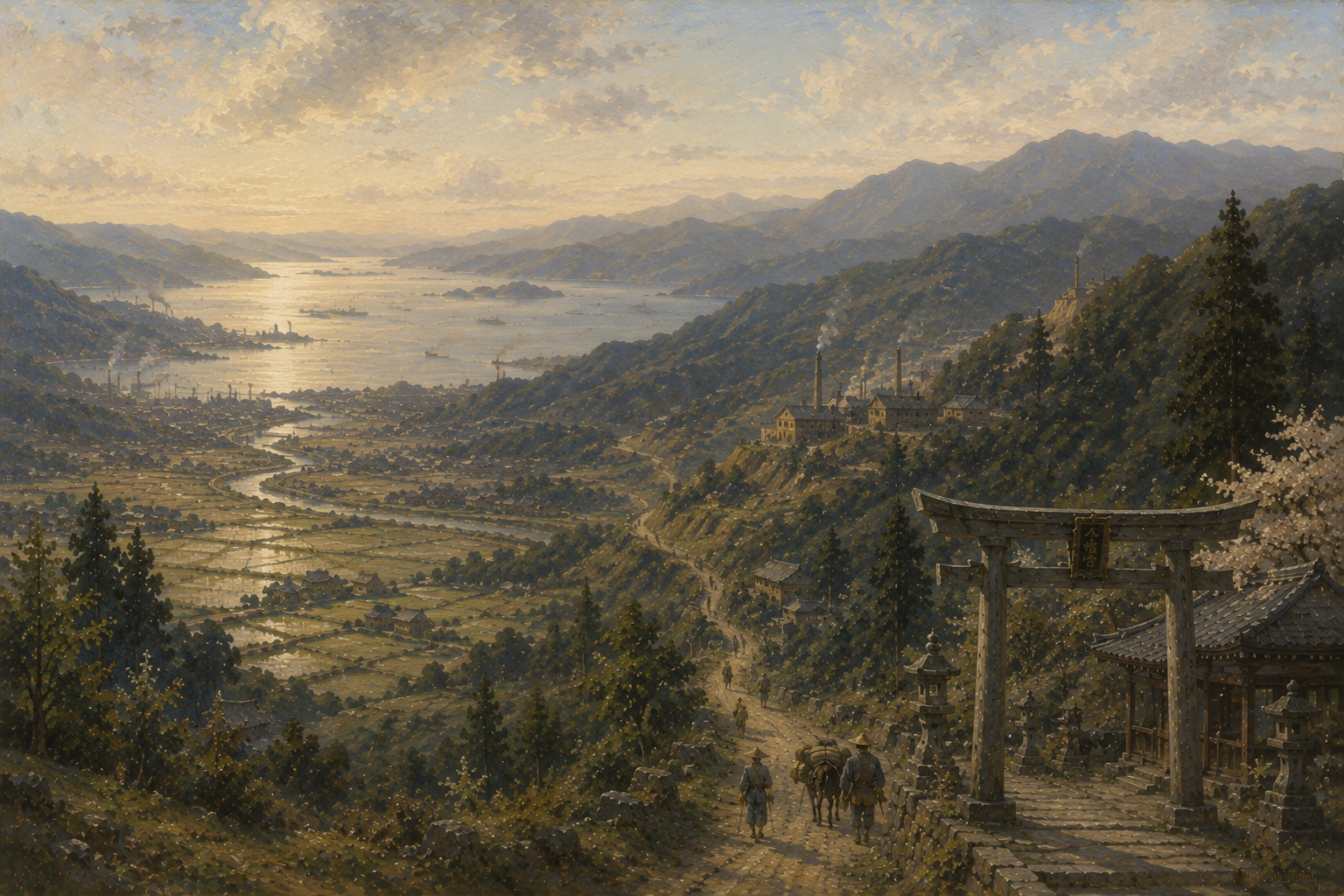
The state, in this narrow window, is proving that it can survive the loss of even its most essential architect and keep building regardless — institutions outlasting the individuals who founded them.
The House spends the same eighteen months proving precisely the same thing on a smaller scale: that the ki Jirō built to survive one crisis can now function as an ordinary, growing concern, absorbing new people, new machines, and new knowledge without needing a crisis to justify any of it.
Book One asked whether the House could survive being remade. Book Two asks whether what it became can actually work — and for the length of this volume, both the nation and the House answer yes.
CHARACTERS
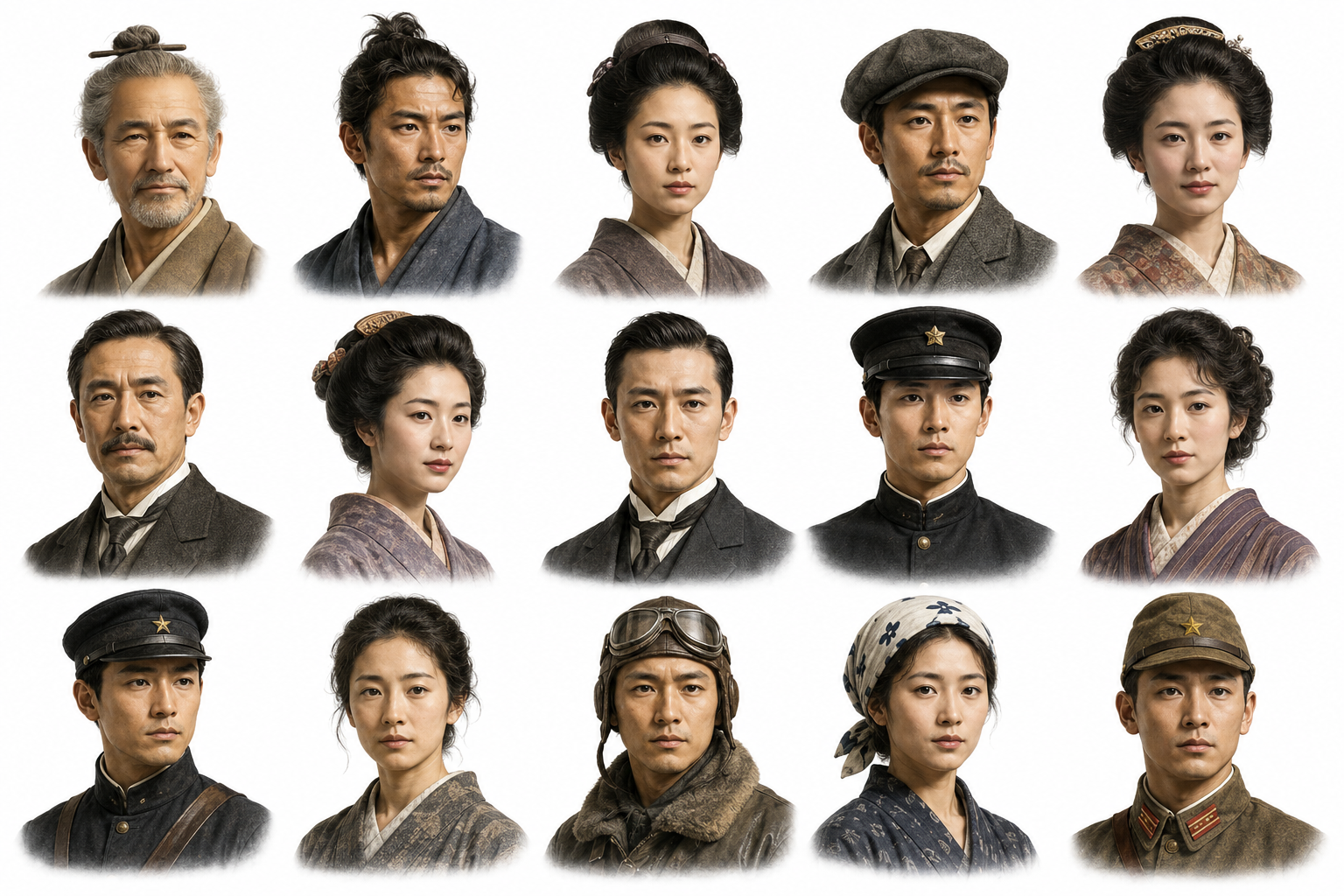
IMPORTANT TO THE STORY
Book Two’s cast doesn’t just grow — it changes kind. Where Book One’s characters were bound to the House by blood, service, or long-standing chōai, this volume is largely populated by people the ki has simply hired: a foreman, apprentices, engravers, an ink master and his wife, translators brought in from within the family itself to do work no outsider could be trusted with yet.
The House is no longer a family with retainers; it is, for the first time, visibly an employer. That shift culminates in the book’s most significant addition — Auguste Baschet, the first character absorbed into the House’s orbit who owes it nothing by blood, service, or nation, arriving instead through commerce and earning his place by character alone.
Even Kento’s and Misaki’s births, both quiet against all this industry, matter here: proof that the House’s private life continues at the same time its public one multiplies. This is a book about how many kinds of belonging one institution can hold at once.
THE CHARACTER LIST
Abe Tombay
Specialists Engaged by the Ki
Headman of the Nomiya boiler works; holds the same place with Ryū that Fujita holds with Saburō.
Arase Taeko
Iwamoto Household
Head woman in the kitchen; briefly absent this book visiting an ailing parent.
Ariga Tomoji
Iwamoto Household
The young stable boy; carries messages and guests between the house and the works.
Ariyoshi Kōji
Fujio House
Clerk to Fujio Hantarō; nephew to Satoko.
Baschet Auguste
The Baschet Circle
Second son of a French engine and loom house, sent to seek commercial opportunity in Asia; met at the Kobe exhibition. Becomes the House’s partner in licensing the Baschet loom, then a settled presence within the household itself by the book’s close.
Deguire Jean
The Baschet Circle
Auguste’s late master and the true designer of the Baschet loom and engine, spoken of throughout in reverence. Present only through Auguste’s account and through a letter Jirō and Auguste write inviting him to Japan.
Fujii Hibiki
Kure House
Master weaver at the Kure weaving works.
Fujio Hantarō
Fujio House
Head of Fujio shōten, a farm-equipment house met through the Kobe exhibition; hosts Saburō and Eiji.
Fujio Satoko
Fujio House
Hantarō’s wife; explores textiles with Mori Nako at the exhibition.
Fujita Ima
Iwamoto Household
Namio’s wife.
Fujita Isamu
Iwamoto Household
Namio’s son; works alongside Saburō through the printing and casting works’ build-out.
Fujita Namio
Iwamoto Household
The elder smith; recommends Itō Junma for the new works and continues to guide Saburō.
Fuyu Tomoo
Iwamoto Printing Works
Young apprentice at the press; becomes its first dedicated pressman.
Gōda Eiko
The Baschet Circle
Matriarch of a Tokyo inn-keeping family; taught Auguste a settling technique he still practises. Present only by reference.
Gōda Mitsugi
The Baschet Circle
Elder Gōda brother, working with Baschet on the engine side of the business.
Gōda Yūto
The Baschet Circle
Younger Gōda brother, working with Baschet on the loom.
Hara Renji
Okada House
Sales manager at Okada shōten; supplies shaft stock, rod stock, and fasteners to the new works.
Hayashi Emon
Hayashi House
Gensai’s son; continues guiding the modernisation of Hayashi Pottery, now with Okada Osachi.
Hayashi Gensai
Hayashi House
Master potter, practitioner of raku.
Hayashi Kenta
Hayashi House
Gensai’s grandson; Osachi’s close friend.
Hirano Etsuji
Iwamoto Household
Mukuro’s son and Hiyori’s younger brother; the carpenter’s apprentice.
Hirano Hiyori
Iwamoto Household
Kitchen girl; continues her care of Otsune.
Hirano Mukuro
Iwamoto Household
The estate’s head carpenter; Etsuji and Hiyori’s father.
Ishii Eigen
Mori House
Nako’s father; master weaver of the Ishii house.
Ishii Rintō
Mori House
Nako’s brother; accompanies her to Osaka on trade business. Not present in Book One.
Itō Junma
Specialists Engaged by the Ki
Master carpenter (tōryō); builds the printing works and continues overseeing construction for the ki.
Iwamoto Aki
Iwamoto House
Masanori’s widow; the House’s moral authority, now overseeing an expanding household.
Iwamoto Chiyu
Iwamoto House
Eiji’s wife; assists Keiko by translating accounting texts, and gives birth to Kento within this book.
Iwamoto Daizen
Iwamoto House
Tadashi’s second son; works in Tokyo under the hotelier Katsura Hidehiko. Present only by reference.
Iwamoto Eiji
Iwamoto House
Tadashi’s third son; brought into the ki as chief interpreter, translating the foreign manuals the House’s new machinery depends on. Physically present this book for the first time.
Iwamoto Hana
Iwamoto House
Aki and Masanori’s daughter; continues her calligraphy training under the old master.
Iwamoto Jirō
Iwamoto House
Katoku of the House; oversees the ki‘s expansion into printing, casting, and the Baschet partnership.
Iwamoto Juri
Iwamoto House
Tadashi’s daughter; present only by reference, in a memory of a visit ten years earlier.
Iwamoto Kari
Iwamoto House
Tadashi’s wife. Not present in Book One; appears here serving her husband and hosting Eiji and Chiyu in Tokyo.
Iwamoto Keiko
Iwamoto House
Jirō’s wife; the ki‘s administrative engine, now overseeing Kuroda Eriko and the House’s growing ledgers. Gives birth to Misaki within this book.
Iwamoto Kento
Iwamoto House
Newborn son of Eiji and Chiyu, born within this book.
Iwamoto Masanori
Iwamoto House
Former katoku, dead since Book One; recalled once, in memory, by Jirō.
Iwamoto Misaki
Iwamoto House
Newborn daughter of Jirō and Keiko, born within this book.
Iwamoto Saburō
Iwamoto House
Aki and Masanori’s second son; the book’s central figure in building and running the new works.
Iwamoto Tadashi
Iwamoto House
Jirō’s uncle. Physically present this book for the first time — earlier known only through correspondence — hosting Eiji, Chiyu, and Jirō in Tokyo.
Katō Akihiko
Katō House
Captains the Kure–Hiroshima steamer; assists Saburō and Ryū’s travel to the exhibition.
Katsura Hidehiko
Katsura House
Tokyo hotelier; patron and near-adoptive employer to Daizen. Present only by reference. Not present in Book One.
Katsura Shina
Katsura House
Hidehiko’s daughter; works alongside Daizen. Present only by reference. Not present in Book One.
Kikuchi Mima
Mori House
Head lady of the Mori house; accompanies Nako and cares for Shinta.
Kinoshita Choki
Iwamoto Printing Works
Head engraver at the printing works.
Kondō Shigeharu
Iwamoto Household
Bantō; continues placing and training new household staff.
Kōno Mitsuo
Okada House
Head of the Okada shōten stores; assists Mori Denji with his work there.
Kuroda Eriko
Iwamoto Household
Formally brought into the main house as Keiko’s assistant at this book’s opening, having impressed Keiko previously.
Mori Denji
Mori House
Nako’s eldest son; now established as a clerk at Okada shōten.
Mori Nako
Mori House
Bunta’s widow; represents the House’s interests in textiles at the Kobe exhibition and helps assess the Baschet loom.
Mori Shinta
Mori House
Nako’s youngest son.
Mori Teruki
Mori House
Nako’s second son. Not present in Book One.
Morita Takeshi
Iwamoto Metal & Casting Works
The lathe man at the Iwamoto works.
Murata Otsune
Iwamoto Household
Senior retainer; nanny to Masanori and Jirō in childhood.
Nishimura Chiyo
Kure House
Jinsuke’s daughter.
Nishimura Jinsuke
Kure House
Headman of Kure House.
Nomiya Atsuki
Specialists Engaged by the Ki
Head of the Nomiya boiler works.
Nomiya Emiko
Specialists Engaged by the Ki
Atsuki’s wife; manages the works’ administration and liaises directly with Hara Renji. Not present in Book One.
Nomiya Ryū
Specialists Engaged by the Ki
Atsuki’s eldest son; Saburō’s close contemporary through the boiler and engine installation, and at the exhibition.
Ogawa Rinne
Iwamoto Household
Aki’s personal lady; greets guests on the House’s behalf.
Okada Genzaemon
Okada House
Keiko’s father; head of Okada shōten.
Okada Osachi
Okada House
Keiko’s brother; builds a kiln and workshop with Hayashi Emon’s guidance.
Rindo Koshi
Specialists Engaged by the Ki
Head of the Nomiya boiler shop; Ryū’s sensei.
Sasaki Riri
Iwamoto Printing Works
Learns the bindery’s first guillotine.
Shiba Kuraji
Iwamoto Metal & Casting Works
First employee and foreman of the casting works, recommended by Fujita.
Tanaka Hatsuo
Okada House
Genzaemon’s retired headman; consulted on the Mori settlement’s continuing administration.
Uyenō Suzu
Iwamoto Printing Works
Yūjirō’s wife; from a family of fine metal pot makers, and a master of metal etching.
Uyenō Yūjirō
Iwamoto Printing Works
Ink master; solves the works’ ink manufacturing.
Wako Enji
Iwamoto Household
The House gardener, seventy-three; a quiet, recurring presence beside Auguste by the book’s close.
Yoshii Michio
Iwamoto Printing Works
Headman of the Iwamoto Printing Works; guides Saburō through its design and operation. Not present in Book One.